Across civilizations, sound has been a vehicle for healing for thousands of years. From the ceremonial drums of indigenous traditions to the church bells of medieval Europe and the resonant gongs of ancient Asia, human beings have instinctively known that sound does something to the body, the mind and the spirit that silence cannot. Now this ancient wisdom is coming home to hospitals, therapy rooms, yoga studios and corporate wellness programmes.
Whether you feel called to explore this field as a personal wellness practice, or as a professional path, you are not alone. The interest in sound healing courses has grown significantly in the past few years. There are so many options out there, from weekend workshops to full year-long programs, that it can be overwhelming knowing where to start and what to look for.
In this guide, we’ll walk you through how sound healing actually works, what learning it involves, how to evaluate programs, and how to take the first confident step towards becoming a practitioner.
Understanding Sound Healing Before You Learn It
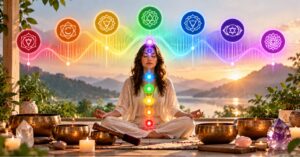
Before enrolling in any sound healing training program it is worth developing a clear picture of what you are actually studying. Sound healing is a therapeutic modality that uses specific frequencies, rhythms and vibrations to influence the physiological and psychological state of an individual. Common instruments include Tibetan and crystal singing bowls, tuning forks, gongs, drums and the voice.
This is physiologically because our bodies are naturally predisposed to be entrained, the synchronization of our biological rhythms to rhythmic patterns in the environment. Brain neural oscillations start synchronizing with a continuous external frequency. This can change brain states from beta (alert, active) to alpha (relaxed, creative) or even theta (deeply meditative), resulting in measurable changes in heart rate, blood pressure, cortisol levels, and reported wellbeing.
What Does Learning Sound Healing Actually Involve?
Sound healing is both an art and a discipline. Learning it well requires engagement across several interconnected domains. Most quality sound healing courses will cover the following areas, whether explicitly or through integrated practice:
- Acoustics and frequency science: Understanding how sound waves behave, what overtones and harmonics are, and how different frequencies interact with the human body.
- Instrument proficiency: Learning to play singing bowls, gongs, tuning forks, or other instruments with control, consistency, and therapeutic intention.
- Anatomy and physiology basics: Understanding the nervous system, stress response, and how the body receives and responds to vibrational input.
- Session design and facilitation: How to structure a session for an individual or group, including intake, environment setup, and aftercare guidance.
- Ethics and professional boundaries: Understanding contraindications, working with vulnerable populations, and maintaining clear professional relationships with clients.
- Personal practice: Most reputable programs require students to develop their own consistent sound practice before working with others, which deepens both skill and embodied understanding.
Types of Sound Healing Courses Available
The landscape of sound healing education ranges from accessible introductory experiences to rigorous professional qualification pathways. Knowing the differences will help you invest your time and resources wisely.
Introductory Workshops and Weekend Immersions
These are ideal for complete beginners who want to explore sound healing as a personal practice or simply experience what it involves before committing to deeper study. They typically run for one to three days and cover the basics of one or two instruments, foundational theory, and a hands-on experience component. They are not designed to qualify you as a practitioner but can be a valuable first step.
Certificate-Level Sound Healing Courses
These programs typically run from several weeks to a few months and offer structured learning across theory, practice, and supervised application. Upon completion, graduates receive a certificate that can support professional practice in wellness centres, yoga studios, and private client work.
Comprehensive Sound Healing Training Programs
A full sound healing training program is designed to produce graduates who are genuinely ready to work with clients in a professional capacity. These programs cover a wider range of instruments, include supervised practice hours, often incorporate anatomy and physiology modules, and may include business development guidance for those looking to build a practice.
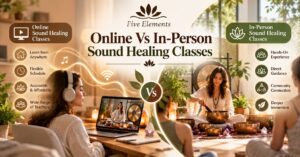
Online vs In-Person Learning
Both online and in-person formats have legitimate value in sound healing education. Online programs offer accessibility and flexibility, allowing students from anywhere to access high-quality instruction. However, sound healing is fundamentally an embodied and experiential practice. The best programs, whether online or in-person, include significant hands-on components.
What to Look for When Choosing a Sound Healing Course
Not all programs are created equal. As interest in sound healing has grown, so has the number of courses available, and quality varies widely. Here are the key factors to evaluate before enrolling:
- Instructor credentials and experience: Who is teaching, and what is their background? Look for instructors with verifiable training, years of practice, and experience working with real clients in therapeutic or wellness contexts.
- Curriculum depth and transparency: A trustworthy program publishes its curriculum clearly. You should know exactly what will be covered, for how long, and in what format before you enroll.
- Supervised practice hours: Any program claiming to produce a certified sound healing practitioner should include supervised practice with real clients, not just classmates or self-practice.
- Student outcomes and testimonials: Speak with or read accounts from previous graduates. What are they doing now? Did the training actually prepare them for professional practice?
- Ongoing support and community: The best programs do not end at graduation. Look for programs that offer alumni communities, continuing education opportunities, or mentorship beyond the initial training.
How The Five Elements Can Help You Begin
If you want to get your feet wet in the world of sound healing, it’s way easier with a knowledgeable guide. The Five Elements is a wellness resource and practice dedicated to helping people explore and engage with sound-based healing in a grounded, informed way. Whether you are wondering what sound healing is before signing up for a course, or are actively trying to figure out which training route will best serve your goals, their guidance can help you avoid a lot of time and uncertainty.
The Five Elements approach to sound healing education is not a sales funnel, but a real conversation about readiness, intention and fit. If you’re sifting through the many sound healing courses out there and want some input from practitioners with real experience, talking to them can help you make an educated choice, not just the most promoted one.
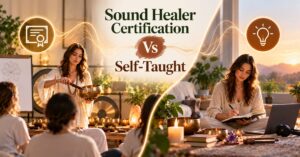
How to Self-Study Sound Healing Alongside Formal Training
Formal enrollment in a sound healing training program is the most structured path to competence, but a great deal of foundational learning can happen before, during, and after formal study. Reading widely across acoustics, music therapy research, neuroscience, and contemplative traditions will enrich your understanding considerably. Authors like Mitchell Gaynor, Fabien Maman, and Jonathan Goldman have written accessibly on the science and philosophy of sound healing.
Attending public sound baths and group sessions as a participant is invaluable. Experiencing skilled facilitation from the receiving end teaches you things that no textbook can. Notice what the practitioner does with pacing, silence, instrument selection, and the arc of the session. These observations will accelerate your learning when you begin your own training.
Developing a personal meditation practice, even a simple one, is widely recommended by experienced practitioners as a prerequisite for working with others. Sound healing asks the practitioner to maintain a quality of attention that is alert, open, and non-reactive. That quality is cultivated through practice, not purchased through enrollment.
Career Paths After Completing Sound Healing Training
The skills of quality sound healing graduates are useful in a surprising variety of professional settings. The most obvious is private practice: providing individual or group sessions for clients seeking stress relief, emotional support or complementary care in addition to conventional treatment.
Many sound practitioners combine their work with other professional roles. Yoga teachers are including sound baths in their classes. Psychotherapists and counselors use tuning forks and singing bowls as tools in their therapeutic work. Massage therapists offer sound as an adjunct to bodywork. School counsellors and HR wellbeing leads have started to introduce group sound sessions as part of mental health support programmes.
The field remains in its professional infancy, so as demand increases the early adopters who invest in quality training and establish themselves with a real track record now will be well placed. The trick is not just to survive a course, but to build that kind of depth and consistency that creates referrals and long-term client relationships.
Conclusion
Whether you want to enrich yourself personally, practice professionally, or understand more deeply the link between sound and human wellbeing, learning sound healing is a worthwhile investment. The trip starts with curiosity and is enhanced by quality education, but it comes of age with consistent personal practice and real-world exposure to people.
The field rewards those that take it seriously. You will gain experience via a weekend introduction. A good sound healing training in noida will lay a foundation for you. Real service to your clients and years of practice will give you mastery. Whatever stage you are on, the most important step is the next step: Learn more, ask better questions, find teachers who have walked this path before you.
And if you want informed guidance on where to start, what to look for, and how to go about this work with integrity, resources like The Five Elements offer the kind of grounded, experience-backed perspective that makes the journey clearer and more purposeful.
Frequently Asked Questions
Q1. Do I need any musical background to learn sound healing?
No. Most sound healing courses welcome complete beginners with no musical training. The instruments used in therapeutic sound work, particularly singing bowls and tuning forks, are chosen in part because they are accessible to non-musicians. What matters more than musical skill is patience, sensitivity, and a genuine willingness to practise consistently.
Q2. How long does it take to become a certified sound healing practitioner?
It depends on the depth of training you pursue. An introductory certificate can be completed in a few weekends. A comprehensive sound healing training program that prepares you for professional practice typically takes anywhere from three months to a year, depending on the program’s structure and your pace.
Q3. Are online sound healing courses as effective as in-person ones?
Online programs can be highly effective for theoretical learning, lecture content, and community connection. However, sound healing is fundamentally an experiential practice. The best online programs include live interactive sessions, in-person intensives, or clear frameworks for supervised practice in your local area.
Q4. What is the difference between a sound bath and sound healing therapy?
A sound bath is typically a group experience where participants passively receive sound in a relaxed lying-down position. It is accessible, widely available, and beneficial for stress relief and relaxation.
Q5. Is sound healing therapy in Noida widely available, and is there a growing community of practitioners there?
Yes. Sound healing therapy in Noida and the broader Delhi-NCR region has grown noticeably over the past several years, both in terms of practitioners offering sessions and individuals seeking training. Wellness centres, yoga studios, and holistic health spaces in the area have increasingly incorporated sound-based modalities.