You hum along to a singing bowl and feel your chest soften. Then a friend says each chakra has its own sound, note, and mantra. Where do you even start?
7-chakra healing with sound combines old yogic ideas with modern listening practices. This guide covers the seven energy centres one by one, with the mantra, popular frequency, and a simple practice for each. It also checks what research says and where the claims run ahead of the evidence. Let’s break it down.
What Is Chakra Sound Healing?
Chakra sound healing uses voice, mantras, bowls, and other instruments to focus attention on each of seven body regions. Practitioners believe each region holds an energy centre. Sessions usually move from the base of the spine to the top of the head, with one sound per stop.
Think of it as a guided tour of your body through listening. You rest your attention on one area, make or hear a matching sound, and then move on. That structure makes it easy to follow at home.
Where Do the Seven Chakras Come From?
Britannica describes chakras as psychic-energy centres of the body in certain forms of Hinduism and Tantric Buddhism. It says each of the seven major chakras is linked to a colour, shape, sense organ, natural element, deity, and mantra.
Traditions do not agree on the number. Buddhist texts mention four or five chakras, while Hindu sources often have six or seven. The best-known seven-chakra version comes from an early 20th century English translation of a 16th century Sanskrit text. The rainbow colours many people now use entered the picture through Leadbeater’s 1927 book.
Here is why that history matters. The chakra system is a meditation map, not an anatomy chart. Chakras are traditionally treated as meditation aids. Treat the seven-part version as one useful model among several.
7-Chakra Healing at a Glance
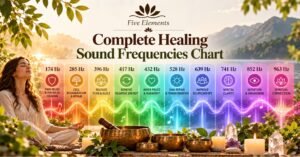
This table shows the usual sound pairings. The mantras come from yoga tradition. The notes and frequencies come from modern charts, and sources differ on them.
| Chakra | Location | Seed mantra | Popular note | Popular frequency |
| Root (Muladhara) | Base of spine | Lam | C | 396 Hz |
| Sacral (Svadhisthana) | Below navel | Vam | D | 417 Hz |
| Solar plexus (Manipura) | Above navel | Ram | E | 528 Hz |
| Heart (Anahata) | Centre of chest | Yam | F | 639 Hz |
| Throat (Vishuddha) | Throat | Ham | G | 741 Hz |
| Third eye (Ajna) | Between eyebrows | Om | A | 852 Hz |
| Crown (Sahasrara) | Top of head | Silence or Om | B | 963 Hz |
What Does Research Say About Chakra Sound Practices?
Start with an honest split. The chakras themselves are a traditional idea. One Tantra scholar points out that chakras are not like organs in the physical body. No scan shows them. So no study can confirm that a sound “opens” a chakra.
Frequency claims need care too. One science explainer says there is almost no scientific evidence that solfeggio frequencies treat physical or mental health conditions. Another notes that controlled studies are scarce. Treat any frequency chart as a starting point for listening, not a prescription.
Related sound practices have early support for relaxation. A 2011 pilot fMRI study of 12 healthy volunteers found that audible “OM” chanting reduced activity in limbic brain regions linked to emotion. The sample was small, so treat it as a promising lead. A 2017 observational study of 62 adults found less tension, anger, fatigue, and depressed mood after a one-hour singing bowl meditation. A 2020 systematic review found only four peer-reviewed studies on singing bowls and could not yet recommend them as therapy.
The takeaway is simple. Use these practices for calm and focus. Do not use them to diagnose or treat illness.
Sound Frequencies and Practices for Each Energy Center
Each practice below takes about two minutes. Sit comfortably, breathe slowly, and keep the volume gentle.
1. Root Chakra (Muladhara)
The root chakra sits at the base of the spine. Tradition links it to safety, stability, and the feeling of having your feet on the ground. Its seed mantra is Lam. Modern charts pair it with the note C and 396 Hz.
Try this: Sit on the floor or a firm chair. Feel your weight press down. Hum “Lam” on a low, steady pitch for seven slow breaths. A large bowl or a soft drum suits this centre well.
2. Sacral Chakra (Svadhisthana)
The sacral chakra sits below the navel. Tradition links it to emotion, creativity, and flow. Its seed mantra is Vam. Charts pair it with the note D and 417 Hz.
Try this: Rest your hands on your lower belly. Chant “Vam” softly and let your body sway a little. Flowing sounds such as a rain stick or gentle water recordings match the theme.
3. Solar Plexus Chakra (Manipura)
The solar plexus chakra sits above the navel. Tradition links it to confidence, willpower, and personal energy. Its seed mantra is Ram. Charts pair it with the note E and 528 Hz.
Try this: Sit tall. Chant “Ram” in short, clear bursts for seven rounds. A steady beat from a shaker or hand drum helps you stay focused.
4. Heart Chakra (Anahata)
The heart chakra sits at the centre of the chest. Tradition links it to love, compassion, and grief. Its seed mantra is Yam. Charts pair it with the note F and 639 Hz.
Try this: Place one hand on your chest. Hum “Yam” gently and think of someone you care about. A soft singing bowl or chimes suit this centre.
5. Throat Chakra (Vishuddha)
The throat chakra sits at the throat. Tradition links it to honest speech and self-expression. Its seed mantra is Ham. Charts pair it with the note G and 741 Hz.
Try this: Chant “Ham” seven times, then hum or sing a song you love. Keep your jaw loose and your voice easy. Never strain.
6. Third Eye Chakra (Ajna)
The third eye chakra sits between the eyebrows. Tradition links it to intuition, focus, and inner sight. Its seed mantra is Om. Charts pair it with the note A and 852 Hz.
Try this: Close your eyes and chant “Om” slowly. Listen to the tail of the sound as it fades. A quiet bowl struck once and left to ring works well.
7. Crown Chakra (Sahasrara)
The crown chakra sits at the top of the head. Tradition links it to stillness and a sense of connection. Charts pair it with the note B and 963 Hz. Many teachers use silence or a soft “Om.”
Try this: Strike a bowl once. Follow the sound until it disappears, then sit in silence for two minutes.
How Five Elements Teaches Chakra Work
Five Elements is a sound healing institute in Gurgaon, and its site lists chakra work in several formats. Here is what it says.
- Chakra Balancing Program: Recorded guided meditations that combine music matched to each chakra, affirmations, and beej mantras.
- Foundation course: An online programme that covers chakra balancing with different healing bowls, plus chimes, shakers, a rain stick, and a manjira.
- Practitioner Level 1 and 2: An in-person programme with modules on seven chakra metal bowls, chakra healing with bowls, and tuning forks.
- Nervous System Reset: Nine guided solfeggio frequency tracks with a personal voice analysis session.
Check the website for current dates and formats before you plan.
A 20-Minute Home Practice in 5 Steps
- Settle in (2 minutes). Sit or lie down in a quiet room. Breathe slowly and let your shoulders drop.
- Start at the root (2 minutes per centre, 14 in total). Work upward from Lam to Om. Use the practice in each section above.
- Keep the sound soft. Hum or chant at a volume that feels comfortable. Pause if you feel dizzy.
- Rest in silence (2 minutes). Let the last sound fade. Notice your breath and body.
- Write one line. Note how you feel, without judging it. Repeat the practice a few times a week and compare notes.
Safety Notes Before You Begin
Reports citing CNN advise people with epilepsy or extreme sound sensitivity to avoid sound baths, and pregnant women to check with a doctor first. Keep volume low, especially with headphones.
Chakra work does not replace medical care. See a doctor for persistent pain, anxiety, or sleep problems. Be wary of any teacher who says a “blocked chakra” caused your illness or who promises a cure.
Next Steps
Start small. Pick one chakra, hum its seed mantra for two minutes, and notice how you feel. Add one centre each session until you can move through all seven. If you want guided audio or live teaching to compare, the Five Elements website lists its chakra programmes and workshops. Keep your expectations modest and your practice regular.
Frequently Asked Questions
Which frequency is best for each chakra?
No frequency has proven benefits for a specific chakra. Popular charts pair 396, 417, 528, 639, 741, 852, and 963 Hz with the seven centres from root to crown. Treat them as listening guides and trust how you feel.
Do I need singing bowls for chakra sound healing?
No. Your voice is enough. Humming seed mantras costs nothing and works well at home. Bowls, chimes, and drums add variety and a physical sense of vibration, so try them later if you enjoy the practice.
How often should I practise?
No proven schedule exists. Many beginners start with 10 to 20 minutes, a few times a week. Keep notes on your mood and sleep, then adjust the length and frequency to suit you.
Is chakra healing scientifically proven?
No. Chakras are a traditional concept that scans cannot measure. Early research on chanting and singing bowls suggests relaxation benefits, but the studies are small and few. Use these practices for calm, not treatment.
What is the right order for the seven chakras?
Most teachers go from root to crown, since that follows the traditional upward path. Some end with a few quiet minutes at the root to feel grounded again. Pick the order that leaves you calm.