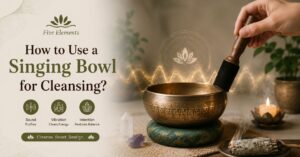
When you sit and listen to a singing bowl, you may notice how the sound vibrates into your body before it even reaches your brain. You feel it wash over you and settle in your chest. Experiencing this sensation is the goal of singing bowl practice. For centuries, individuals in Nepal, Tibet, and northern India have used metallic bowls during healing and spiritual rituals. Now, you can learn how to use these bowls for cleansing and peace of mind in your own home.
In this guide, we cover how to use a singing bowl for cleansing step by step so you can try it out for yourself.
What is a Singing Bowl and Why People Use It for Cleansing
A chakra singing bowl set is a collection of specially crafted singing bowls designed to support meditation, sound healing, and chakra balancing. A singing bowl is basically a bell-shaped metal bowl, often made of a bronze alloy with copper and tin, while some contain a mixture of many metals. You hit it or rub a mallet around the rim, which creates vibrations that resonate through the metal, producing a long-lasting, rich, and overlapping tone. The bowls in a Chakra Singing Bowls Set generate complex beat frequencies that align with meditative brainwave states, helping promote deep relaxation, mindfulness, and inner balance. This is one reason their soothing sound is perceived as calming rather than irritating.
When I say cleansing, I don’t mean cleaning with soap and water. Cleansing, in this practice, is the act of using sound and vibration to energetically remove stale energy from a room, object, your mind or body. Himalayan villagers once used singing bowls as part of a healer’s toolkit. Many believed sound and vibration could aid in balancing energy, cleansing and helping to heal a variety of aches and pains. No matter how you look at it spiritually or as a relaxing ritual, the practice is the same.
How to Use a Singing Bowl for Cleansing (Step-by-Step)
Here is a simple sequence you can follow, whether this is your first time or your fiftieth.
- Find a quiet space. Turn off fans, phones, and background noise so you can actually hear the full sound decay.
- Sit comfortably. Cross-legged on the floor or on a chair, spine upright but not stiff.
- Hold the bowl flat on your open palm or place it on a cushion in front of you.
- Strike the rim gently with the padded end of the mallet to start the tone.
- Circle the rim slowly with steady, even pressure to sustain the sound if you want it to build.
- Set an intention before you begin, such as clearing tension from the day or resetting the mood of a room.
- Let the sound fade completely before you strike or circle again. Silence is part of the practice, not a gap in it.
- Repeat 3 to 5 times, moving slowly around a room if you are cleansing a space, or staying seated if you are cleansing yourself.
Choosing the Right Bowl
Beginners often do better with a medium-sized bowl, somewhere between 5 and 7 inches, since it is easier to control both the strike and the rim technique. Handcrafted bowls, like the ones you will find in collections from Nepal and India, tend to carry richer overtones than mass-produced ones because of how the metal is hammered by hand. If you are shopping around, look at how a bowl is made and where it comes from rather than only its price tag.
Setting Up Your Space
A cleansing session does not need candles or incense to work, but a clear, uncluttered corner of a room helps. Open a window if you can. Some people like to sit near a plant or a natural light source. None of this is mandatory. What matters more is that you are not rushing.
Different Techniques to Cleanse a Room or Space
There are a few common ways to use a singing bowl for cleansing a room rather than yourself:
- The walking method: Hold the bowl and walk slowly along the walls of a room, striking it every few steps.
- The corner method: Sit in the center of a room and strike the bowl facing each of the four corners in turn.
- The doorway method: Ring the bowl once at each entrance and exit of a space, since doorways are often treated as transition points for energy.
Any of these works. Pick whichever feels natural rather than overthinking the “correct” one.
Cleansing Yourself vs Cleansing Your Space
Cleansing yourself usually means placing the bowl near your body, sometimes on your chest, stomach, or lap while lying down, and letting the vibration travel through you as it rings. Cleansing a space means moving the sound through the room itself. Many people do both in one sitting: they start with a few minutes of personal grounding, then walk the bowl around the room before ending the session.
What Does Science Say About Singing Bowl Sound?
This isn’t just anecdotal either. Several clinical studies have investigated what actually occurs in the body throughout a singing bowl therapy session. In one observational study analyzing singing bowl sound meditation, results showed that the tension subscale, specifically, showed highly significant results for participants after sound meditation, lending support to the theory that sound meditation increases relaxation and decreases stress. That same study mentioned that Tibetan singing bowl meditation may be a feasible low-cost and low technology alternative for decreasing tension, anxiety, and depression scores while increasing spiritual well-being. Adding physiological evidence to these claims, a heart rate variability study done recently reported significant improvement in overall heart rate variability with increases in measures suggesting increased parasympathetic activity and a relaxation response.
Pulling together 14 separate studies, a 2025 systematic review concluded that Tibetan Singing Bowl interventions may be a promising avenue for decreasing stress and promoting psychological well-being, working as a non-invasive, low-risk method that can be applied in both clinical and community settings. For those wondering, Are Singing Bowls Against Christianity, current scientific research focuses on their potential mental health and relaxation benefits rather than any religious beliefs or spiritual doctrine.
It doesn’t mean singing bowls can replace medical treatment. But it does help illuminate why so many grab one when they need to wind down.
Common Mistakes to Avoid
- Striking too hard. A firm, controlled tap works better than force. Hard strikes create a harsh sound, not a fuller one.
- Rushing the rim technique. If the bowl is not singing, slow your circling motion down rather than pressing harder.
- Skipping the silence. The pause after a tone fades is where a lot of the calming effect settles in.
- Using a poor-quality bowl. Thin, machine-stamped bowls often produce a flat sound with little sustain.
- Doing it while distracted. Even five focused minutes work better than twenty minutes with your phone buzzing nearby.
Tips for Daily Practice
You don’t need to do an hour long ritual every day. Just take 2-3 minutes every morning before looking at your phone to set yourself up for a more peaceful day. If you’re just getting started there are companies that offer courses that teach sound healing through curriculum (Like Five Elements) where you can learn how to properly strike and use rim technique from someone who knows rather than learning completely from trial and error.
Final Thoughts
Study after study has shown that using a singing bowl properly for cleansing isn’t about getting the ritual right. It’s about doing it regularly. Sit. Strike the bowl. Allow the sound to wash over you. Pay attention to how your body reacts. Do this for a few weeks and you’ll likely find that technique goes out the window. You just feel compelled to sit quietly with the sound. Five Elements philosophy of sound therapy revolves around this concept: a simple tool, when constructed well and used mindfully can work wonders for the frazzled nervous system.
Frequently Asked Questions
- How often should I use a singing bowl for cleansing?
Daily use is fine for most people. Even a short two to three minute session works. Some people prefer weekly deeper sessions instead of daily short ones. There is no fixed rule, so match the frequency to your schedule and how your body responds.
- Can I cleanse my home with a singing bowl if I live in an apartment?
Yes. Walk the bowl through each room, pausing at doorways and corners. You do not need a large space. Just make sure neighbours are not disturbed if you are practicing early morning or late at night.
- Do I need an expensive bowl to get results?
No. A well-made mid-range handcrafted bowl works fine for beginners. What matters more is consistent practice and correct technique rather than the price of the bowl itself.
- What is the difference between a metal singing bowl and a crystal one?
Metal bowls produce warmer, layered tones from alloy vibrations. Crystal bowls, usually made from quartz, produce clearer and higher-pitched tones. Both are used for cleansing, and the choice often comes down to personal preference in sound.
- Is there scientific proof that singing bowls reduce stress?
Several published studies report measurable drops in tension and improved heart rate variability after singing bowl sessions. Researchers describe it as a promising, low-risk relaxation tool, though it works best alongside, not instead of, medical care.