When you run out of words, sometimes sound can heal. Traditional therapies have their place, but there are times when sound enters where talk therapy can’t go. Sound healing has been life changing for many trauma survivors on their healing journey, not as a replacement therapy, but as a powerful complement to restoring wellbeing.
Trauma impacts each of us in different ways, but we all know it when we feel it. Trauma is embodied. It’s stored in our muscles, our breath, and our nervous systems. Sound healing works on trauma because it reaches those memories that we can’t seem to shake. It communicates in a different frequency, one that doesn’t rely on cognitive thought.
The Science Behind Sound and Trauma
Did you know that our entire body is made up of vibrating energy? Each cell, tissue, and organ vibrates at its own unique frequency which resonates together to make up our own personal frequency known as our body’s natural resonance. When we experience trauma, it alters these frequencies and creates disharmony within our systems, both physically and emotionally. That’s where sound healing therapy can help, especially for brain function.
Research has shown that trauma can impact brainwave activity. When we experience trauma, it affects the connection between our amygdala (fight or flight center of the brain) and our prefrontal cortex (the center of reason and logic in our brain). Sound healing uses vibrations to help balance our brainwave activity, especially in the alpha and theta ranges. These two ranges are where we process emotions and feel relaxed.
Brain scans have shown that sound healing can decrease activity in the part of the brain that’s responsible for overthinking and that chatter in our heads. (This part of the brain is often overactive in those that have experienced trauma.) It also shows that sound healing can increase coherence in the brain. Coherence means that there is healthy communication between the different frequencies in our nervous system.
The Turning Point: When Sound Meets Stored Trauma
“One minute, nothing’s happening, and the next minute, bang,” vibrational medicine practitioners recount. “You see someone sobbing freely, without forcing tears. You watch chronic muscle tension melt away that someone’s lived with for years. Or maybe a memory floods back in a comforting way, instead of a triggering way.” These are literal changes to where our traumas are held in the body.
Various instruments create different pathways to healing:
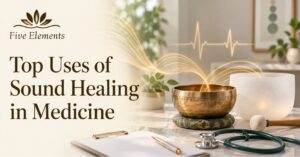
- Tibetan singing bowls produce rich, complex overtones that can induce deep meditative states and nervous system regulation
- Crystal singing bowls emit pure tones that practitioners believe correspond to specific energy centers in the body
- Gongs create a wash of sound that can temporarily override the mind’s habitual patterns, creating space for new neural pathways
- Tuning forks apply precise frequencies to specific areas, potentially releasing localized tension and trauma
- Voice and toning engage the vagus nerve directly through vibration in the throat and chest, activating the body’s natural calming mechanisms
What distinguishes sound healing from other modalities is its non-invasive nature. There is no need to recount traumatic events, no requirement to analyze or understand. The body simply responds to vibration, allowing what needs to be released to do so at its own pace.
Building Competence in Sound Healing Practice
If you feel called to do this work, then yes, it is important to learn how to do so safely. A 4 days sound healing course can give you an overview of various instruments, introductory techniques, and safety tools. Weekend workshops are great for getting started and learning practical skills right away.
Sound healing with trauma is different though. Dealing with trauma requires more understanding and experience. Programs like 50 hours sound healing courses cover topics such as the neuroscience behind trauma, ethics when working with trauma, advanced techniques, and the healer’s personal healing process. These courses teach you that as sound healers, we must do the inner work ourselves in order to be of service and create space for others.
Quality training programs typically cover:
- Neurophysiology of trauma and how sound affects the nervous system
- Proper use and care of various healing instruments
- Creating safe containers for emotional release
- Recognizing when additional support or referral is needed
- Cultural sensitivity and the sacred origins of sound healing traditions
- Self-care practices for practitioners to prevent secondary trauma
The most effective practitioners combine technical skill with deep presence, understanding that they are not fixing anyone but rather creating conditions where the body’s innate healing capacity can activate.
Integrating Sound Healing Into Holistic Recovery
Sound healing almost never occurs in a vacuum when it comes to effective trauma healing work. Most modalities are used as part of an integrated blend that may include somatic work, mindfulness and meditation, movement, and even traditional therapies when indicated.
Clients report that sound healing helps open pathways that allow other healing to take place. When our nervous systems are regulated with sound healing, things like talk therapy can suddenly click. Yoga postures we never thought we could access may become available as trauma stored in the body softens. Relationships can shift as your body no longer feels the need to brace for attack.
The Five Elements understands this need for blended support. We know that true healing occurs within systems, not in isolated instances. Our Centre spaces were developed to allow for deep healing modalities that can touch you in all aspects of your being, body, mind and spirit.
What to Expect in Your First Sound Healing Session
Knowing what to expect can help lessen anxiety around receiving sound healing work, especially if you’re looking into this modality as a tool to help heal trauma. A sound healing session will usually start with a short check-in about your intentions for the session and any areas of the body or feelings you want to pay special attention to. You then get comfortable on a mat or massage table, covered with blankets.
You’ll hear the practitioner start making sounds. Sometimes they start softly then gradually crescendo into louder, stronger vibrations. Other times they may start BIG and then allow their sounds to ease into gentler tones. There is no correct way to receive sound healing. Some people sleep, some stay awake and alert. Some have visualizations, memories come up, others just feel the sensations in their body.
This is why sound healing can be so effective for trauma survivors. There are many modalities out there that go “too deep” too fast for someone who has been through trauma and that’s re-traumatizing. After your session you may want to allow yourself some time to integrate your experience. This may look like sitting in silence, journaling, or gentle movement. Drink some water and be easy on yourself for the next few hours/days.
The Role of Five Elements in Your Healing Journeys
Dedicated healing spaces serve important functions in recovery. The Five Elements, for instance, provides not just a physical location but an energetic container purposefully designed for transformation. When trauma survivors enter such spaces, they encounter environments where healing is expected and normalized, where their experiences are understood, and where expertise meets compassion.
These specialized centers often offer structured programs that guide individuals through progressive stages of healing. Rather than one-off sessions, they provide coherent pathways that address trauma recovery systematically, allowing each session to build upon previous work.
Beyond individual sessions, healing centers frequently foster community among participants. This connection with others on similar journeys can itself be profoundly therapeutic, countering the isolation that trauma often creates. Sharing space with others who understand, without need for explanation, offers its own form of healing.
When Sound Healing Becomes Your Practice
As you progress in your healing journey, you might feel called to develop your own sound healing practice. This could mean simply incorporating toning, humming, or listening to specific frequencies into your daily routine. The voice is an incredibly powerful sound healing instrument that you carry with you always.
For some, this call deepens into the desire to facilitate healing for others. This path requires both personal healing work and professional training. Recognizing that we teach what we most need to learn, many sound healing practitioners find that guiding others becomes part of their own ongoing recovery.
Home practice might include:
- Daily toning or humming to stimulate the vagus nerve
- Listening to recorded sound healing sessions during meditation
- Using singing bowls or chimes as part of morning or evening rituals
- Incorporating healing frequencies through apps or streaming platforms
- Joining online or in-person sound baths regularly
The Future of Trauma Recovery Through Sound
As neuroscience continues validating what ancient traditions have known for millennia, sound healing is moving from the margins to mainstream trauma treatment. Hospitals, mental health clinics, and rehabilitation centers are increasingly incorporating sound healing into their programs.
Research is expanding, with studies examining specific frequencies for particular conditions, optimal treatment protocols, and mechanisms of action. This scientific validation, while valuable, confirms rather than discovers, it simply articulates what practitioners and recipients have experienced directly.
The integration of technology offers new possibilities. Biofeedback devices can now measure nervous system responses to different frequencies in real time. Apps provide accessibility for those unable to attend in-person sessions. Virtual reality environments are being designed to enhance sound healing experiences.
Yet the essence remains remarkably simple: vibration, properly applied, helps restore coherence to systems disrupted by trauma. This elegant simplicity is sound healing’s great strength.
Making the Choice to Begin
Maybe you’ve been wanting to try sound healing but find yourself stuck on actually booking an appointment. Know that resistance itself can be a part of trauma talking. The piece that knew it had to keep quiet and small to survive. And also know that only you can tell when you’re ready.
One thing that helps me is to reframe it. You are not signing yourself up for X result or agreeing to any long term treatment plan. You are booking one session, one experience, one chance to offer your nervous system something new to feel.
Clients who’ve experienced trauma have often told me that sound healing was the first practice that made them feel safe in their body again. Many years of living as an alien in your own body were melted away by the vibrations washing over you, bringing you home to yourself.
Sound might be that one glimmer of light for you too. It could come from a singing bowl or gong or it could come from your own voice. Trauma recovery is often just taking one baby step at a time. And that baby step might look like lying down.
Frequently Asked Questions
How long does it take to see results from sound healing therapy for trauma?
Results vary by individual, but many people experience immediate nervous system relaxation after their first session, including better sleep and reduced anxiety. Deeper trauma processing typically unfolds over several weeks to months of regular sessions. Consistency matters more than duration—weekly sessions for three months often prove more effective than monthly sessions for a year.
Is sound healing therapy for brain function scientifically validated?
Yes, growing research demonstrates sound healing’s effects on brain function. Studies using EEG and fMRI show changes in brainwave patterns, reduced amygdala activation, and increased prefrontal cortex engagement during and after sound healing sessions. Research particularly supports sound healing’s ability to shift brainwaves into alpha and theta states associated with relaxation and emotional processing.
What’s the difference between 4 days sound healing courses and 50 hours sound healing courses?
Four-day courses provide foundational knowledge, basic techniques, and hands-on experience with various instruments—ideal for personal practice or beginning practitioners. Fifty-hour courses offer comprehensive training including trauma neuroscience, ethical considerations, advanced techniques, business aspects, and supervised practice—necessary for professional practitioners working with trauma survivors.
Can sound healing replace traditional trauma therapy?
Sound healing is most effective as part of an integrated approach rather than a replacement for other therapies. It works exceptionally well alongside somatic therapy, EMDR, or talk therapy, often making these modalities more effective by regulating the nervous system. Always work with qualified professionals and discuss your full treatment plan with your healthcare providers.
Are there any risks or side effects to sound healing?
Sound healing is generally safe with minimal side effects. Some people experience emotional releases (crying, anger), temporary fatigue as the body processes, or increased dreams. Certain conditions require caution: pregnancy (particularly with low-frequency instruments), epilepsy, sound-sensitive conditions, or metal implants near where instruments are placed.