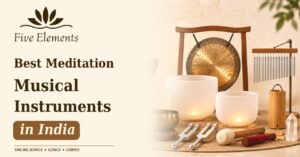
The gong is one of those instruments that just commands attention when played in a space. A single tap will produce a low humming sound which gradually grows louder with overtones. This is what makes the gong a favorite among sound therapists.
There are so many types of gongs to choose from though. When you enter a gong store (online or physical) you may get overwhelmed. Should I go for a symphonic gong or planetary gong? Chau or wind? Do I need a 28″ or 36″? Gongs can be quite expensive (especially the bigger European ones). So you want to make sure you pick the right one.
This guide breaks down the main gongs for sound healing, what each one sounds like, and who it suits. It comes from Five Elements, a Gurgaon-based sound healing training centre where gong work forms part of the practitioner courses. Let’s break it down.
Quick Answer: Top 5 Gong Styles for Healing Work
Gongs used in sound healing fall into five broad styles. Here is how they compare at a glance.
- Symphonic gong: best all-rounder for sound baths, with a clear base note and balanced overtones.
- Planetary tuned gong: best for tuned therapy work, as each gong matches a frequency from Hans Cousto’s “Cosmic Octave”.
- Chau gong: best traditional choice, with a deep, controlled, grounding voice.
- Wind gong (Feng gong): best budget pick for beginners, with a bright, shimmering sound that opens fast.
- Nipple gong: best for precise, bell-like tones and rhythm work.
For a first serious gong, a 28 to 32 inch symphonic or planetary gong makes a good starting point. If budget matters more, a 26 to 30 inch wind or chau gong is a sensible start.
How a Gong Works in a Sound Healing Session
Before comparing types, it helps to know what you are listening for.
A gong has two broad layers of sound. The base note is the low, steady tone you hear first when you strike gently. The overtones are the higher, shifting tones that bloom as you play with more energy. Some gongs hold a clear base note. Others release a wash of overtones almost at once.
In a gong bath, participants lie down while the facilitator plays one or more gongs, usually starting soft and building slowly. Many people describe the feeling as sound washing over the body. The gong you choose shapes that experience more than any other single factor.
Types of Gongs for Sound Healing Explained
1. Symphonic Gongs
Symphonic gongs come mainly from European makers such as Paiste and Meinl. They share the shape of the traditional Chinese chau gong, with a turned rim, but their makers finish them to a much finer standard.
Paiste describes the aim as balancing the gong’s base note with its rich overtones. In plain words, you get a clear, musical note that stays harmonious even when you play loud.
- Sound: warm, clear, full-bodied
- Common sizes: 20 to 38 inches
- Best for: professional sound baths, one-on-one sessions, studio work
- Watch out for: higher prices than Asian-made gongs
2. Planetary Tuned Gongs
Planetary gongs take tuning a step further. Swiss mathematician and musicologist Hans Cousto calculated frequencies linked to the orbits of the Earth, Moon, Sun and planets in his work The Cosmic Octave. Makers then hand-hammer each gong to match one of those frequencies.
Here are a few examples from Meinl’s Sonic Energy range:
- Earth (36 inch): 136.10 Hz, weighs about 11 kg
- Mars (32 inch): 144.72 Hz, weighs about 7.6 kg
- Venus (24 inch): 221.23 Hz, weighs about 4 kg
Meinl makes these gongs in Germany from nickel silver, in sizes from 24 to 36 inches. Paiste’s Planet Gongs run from 24 to 38 inches.
- Sound: similar to symphonic gongs, with a strong, defined base note
- Best for: practitioners who pair gongs with tuning forks, bowls or chanting at matching pitches
- Watch out for: sellers’ claims about planetary “effects” on mood or health, which come from tradition, not clinical research
3. Chau Gongs (Chau Tam Tam)
The chau gong is the classic Chinese gong, with a wide, folded-back rim and a polished playing area. Meinl explains that this rim gives the surface more tension, so the sound unfolds more slowly than a wind gong.
- Sound: deep, earthy, controlled, with long sustain
- Material: usually a copper and tin bronze alloy
- Best for: grounding work, slow meditations, players who like patience in their sound
- Watch out for: weight, as chau gongs tend to be heavier than flatter gongs of the same size
4. Wind Gongs (Feng or Sun Gongs)
Wind gongs look almost flat, like a plate with very little rim. Because of that shape, they respond quickly. A light tap gives a surprisingly low note, and a firmer stroke opens into a bright, roaring wash of sound.
Gong makers often point out that a wind gong can give as much bass as a larger chau gong. So a 26 inch wind gong may sound as deep as a 30 to 32 inch chau.
- Sound: shimmering, lively, bright
- Best for: beginners, travelling facilitators, budget-conscious buyers
- Watch out for: how fast it can get loud, which takes practice to control
5. Nipple Gongs
A nipple gong has a raised boss, or bump, in the centre. Striking the boss gives a focused, pitched, bell-like tone, quite different from the wash of a flat gong.
- Sound: precise, clear, bell-like
- Best for: marking the start or end of a session, rhythm work, pairing with bowls
- Watch out for: less overtone wash, so it rarely works as the only gong in a sound bath
A Note on Other Gongs
You may also see opera gongs, which slide down in pitch after a stroke, and special-effect lines such as Paiste’s Sound Creation gongs. These add colour to a session but suit experienced players better as a second or third gong.
Gong Size Guide: Which Diameter Should You Choose?
Size changes depth, volume, weight and cost. Here is a simple guide, using Meinl planetary gong weights as a reference point.
| Diameter | Approx. Weight (Meinl planetary) | Sound Character | Suits |
| 24 inch | about 4 kg | Higher, lighter, easy to control | Home practice, small rooms, travel |
| 28 inch | about 5.4 kg | Balanced depth and control | First professional gong |
| 32 inch | about 7.6 kg | Deep, full, room-filling | Group sound baths |
| 36 inch | about 11 kg | Very deep, powerful | Large halls, experienced players |
Weights differ by maker and style, so always check the product listing. Remember to budget for a sturdy stand too.
Mallets: The Other Half of the Sound
The same gong can sound gentle or thunderous depending on the mallet.
- Soft felt or fleece mallets bring out the warm base note. Most gong baths rely on these.
- Heavier, larger mallets draw out deeper tones from big gongs.
- Rubber friction mallets, often called flumis, glide across the surface to create singing, whale-like sounds.
Start with one soft mallet and one friction mallet. Add more once you know your gong’s voice.
How to Choose the Right Gong: 6 Steps
Ready to pick? Follow these steps.
- Define your use. Personal meditation, private clients or large group sound baths each need a different size and style.
- Set a realistic budget. Include the stand, mallets, a cover and shipping, which can add a lot for imported gongs.
- Listen before you buy. Play the gong yourself if you can, or ask for an unedited recording of the exact piece.
- Choose tuned or untuned. Pick a planetary or tuned symphonic gong if you plan to match pitches with other instruments.
- Check the weight. Make sure you can lift, carry and hang the gong safely, especially if you travel to venues.
- Learn proper technique. A gong played badly can overwhelm listeners. Training makes a bigger difference than the brand.
Is Gong Sound Healing Safe? What to Know About Volume
Since you can get quite loud with a gong it’s something to be careful of.
According to the United States National Institute for Occupational Safety and Health they say you should only be exposed to 85 dBA over an 8 hour period. Every time it increases by 3 dB it cuts your exposure time in half. So if your gong is at 100 dBA you should limit your playing to under 15 minutes a day.
A fellow gong player tested his playing and found he was producing around 80-97 db from just a few feet away from his gong. These short bursts of sound are not harmful. If you were playing at higher volumes for longer periods of time you could exceed the guidelines from NIOSH in less than an hour. So make sure to play at safe levels.
Here is how to keep sessions comfortable:
- Start soft and build slowly, rather than opening with a loud stroke.
- Keep distance. Place mats at least a few feet away from the gong.
- Take extra care with children, whose ears are more sensitive to strong sound.
- Screen participants. Gong baths may not suit people with epilepsy, pregnancy, hearing aids or hearing problems, or some mental health conditions. Ask them to check with a doctor first.
- Watch for warning signs. Ringing ears or muffled hearing after a session means the volume was too high.
What Does Research Say About Gong Baths?
There has been little research done on just gongs. In 2022 there was an observational study done in the Journal of Religions. They followed 62 individuals during their sound healing practices with singing bowls, gongs and other instruments. There was a correlation between an increase in spiritual wellness and decrease in tension/depressed mood after their session.
Since there was no control group this study can’t say that one causes the other. Use gong baths as a form of relaxation/meditation. Not as a substitute for your medical needs.
Final Thoughts
So, which gongs are best for sound healing? For most practitioners, a symphonic or planetary gong between 28 and 32 inches offers the best mix of clarity, depth and control. Chau gongs suit those who want a slower, earthier voice, and wind gongs give beginners an affordable, expressive start.
The gong matters, but the player matters more. If you want to learn safe, structured gong technique alongside bowls and tuning forks, Five Elements covers gong work in its sound healing courses.
Frequently Asked Questions
1. Which gong is best for beginners in sound healing?
A 26 to 30 inch wind gong or chau gong suits most beginners. Both cost less than European symphonic gongs and still give a deep, full sound. Pair it with one soft mallet and practise gentle, slow strokes before playing for groups.
2. What is the difference between a symphonic and a planetary gong?
Both share a similar shape and sound. A symphonic gong focuses on a balanced, musical tone without a fixed target pitch. A planetary gong is hand-tuned to a specific frequency from Hans Cousto’s Cosmic Octave, such as 136.10 Hz for the Earth gong.
3. What size gong is best for a sound bath?
For group sound baths, many practitioners choose a 32 to 36 inch gong, which fills a hall with a deep tone. For home practice or small rooms, a 24 to 28 inch gong is easier to control, carry and store.
4. Can a gong damage your hearing?
It can be played loud for long periods at close range. NIOSH advises keeping exposure under 85 dBA over eight hours. Build volume slowly, keep listeners a few feet away, and stop if anyone reports ringing or discomfort.
5. Are Paiste and Meinl gongs worth the price?
Many professionals prefer them for their consistent build, clear base note and accurate tuning. Asian-made chau and wind gongs cost far less and suit many practitioners well. Listen to several gongs before deciding, as personal taste matters as much as brand.