At some point in life, everyone experiences a singular moment.
They enter a room where a Tibetan singing bowl is being played. They sit down unconvinced. They close their eyes and the sound washes over them. After a while—the three-minute mark maybe—the tension in their jaw eases. The knots in their shoulders soften. And all of the anxious thoughts racing around their brain since 6am suddenly come to a halt.
For a moment they sit there wondering…what is this magic?
Turns out it’s older than we usually give it credit for. For thousands of years, humans have been practicing sound as medicine. Even before doctors and drugs, ancient cultures all over the world were using specific sounds, rhythms, and instruments to make people feel better. They noticed that sound had an ability to change the body’s perception, so they developed entire healing practices around it.
We’re just now starting to understand why.
Here are 10 ancient sound healing instruments, their history, and what they do to the mind and body.
1. Tibetan Singing Bowls
Origin: Tibet, Nepal, and the Himalayan region
If there is one instrument that has come to define the modern sound healing movement, it’s this one. Tibetan singing bowls have been used for centuries by monks in Tibet and Nepal as part of their healing and meditation ceremonies. Bowls crafted from alloys of different metals produce their intense vibrations like this:
Why do they work? When struck or circled with a mallet, the singing bowl produces a complex sound that resonates multiple frequencies at once. Those frequencies enter your body through your ears but also through the vibrations traveling up the surface beneath the bowl, through the floor, and into your body.
An exhaustive review of 14 studies conducted over 16 years and published in 2026 in Healthcare (MDPI) found Tibetan singing bowl meditation sessions have been shown to produce measurable decreases in anxiety and depressive symptoms, heart rate, and increases in HRV (heart rate variability), delta and theta brainwave activity (the latter two being markers of deep, meditative relaxation).
Here at Five Elements, our online sound healing courses include singing bowls as one of the core instruments taught in sound healing practitioner training because they produce results this fast and this consistently, few other instruments can.
Primary uses: Stress reduction, anxiety relief, sleep support, meditation deepening, pain management.
2. The Didgeridoo (Yidaki)
Origin: Aboriginal Australia, over 40,000 years ago
The didgeridoo is considered by some to be the oldest wind instrument still played today. Used by Aboriginal Australians, who referred to it as the yidaki—in healing rituals, it was placed against the ailing person’s head or torso and played directly over his or her body.
Let’s dig into the physics of this. The didgeridoo creates very low-frequency sound. This deep drone is full of harmonic content. When you feel that drone vibratory through your body rather than simply hear it, it functions very similarly to therapeutic ultrasound. The Aboriginal elders knew this. Science is just beginning to measure it out.
Research published in Global Advances in Health and Medicine, which used a randomized controlled design at UNC Chapel Hill, showed that sound meditation with the didgeridoo creates quantifiable decreases in stress and enhanced positive mood in participants. Published in the Journal of Rural Health, another study found improved pulmonary function and overall well-being in Aboriginal youth who were taught how to play the didgeridoo.
Primary uses: Stress and anxiety reduction, respiratory support, nervous system regulation, altered meditative states.
3. The Shaman Drum
Origin: Indigenous cultures across Siberia, Central Asia, the Americas, and Africa
Before the singing bowl, before the gong, there was the drum.
From Siberia to South America, every indigenous shamanic culture on the planet constructed their healing rituals around drumming. Drums were never used randomly. Shamanic style drums pulsate at a frequency between 4 and 7 beats per second. That sweet spot is where your brain enters theta wave states.
How does this work? Repetitive drumming at that pace will begin to entrain the brain. This basically means the drumming guides the brain’s electrical patterns to sync to the beat. As you know when you enter theta states, the body experiences deep relaxation, decreased pain sensations and enters the hypnagogic state where our emotions flow freely and can be processed.
Primary uses: Stress reduction, emotional release, immune support, trance induction for deep meditative work.
4. The Ancient Egyptian Sistrum
Origin: Ancient Egypt, first appearing in the Old Kingdom, approximately 2700 BCE
You won’t believe which tool this is. The humble sistrum or ‘Sheshsin’ looked like it was nothing more than a religious shake, rattle and boom. Carried by priestesses and pharaohs into ancient Egyptian healing temples it was essentially just a looped piece of material with loose metal discs inside that made a tinkling sound when moved.
Known to have first been used during the Old Kingdom period as belonging to the goddess Hathor according to the World History Encyclopedia, hieroglyphics found around Egyptian temples actually refer to the sistrum generating a “rejuvenating breath.” That breath was said to specifically target the sinus cavities and nasal passageways. We now know that vibrating that area promotes nitric oxide production which helps vasodilate blood vessels and assists with respiration.
Temples were also specifically built with healing in mind and the architecture included chambers specifically designed to amplify certain frequencies. The sistrum, along with harps and chants were used as part of a very organized sonic therapy regimen.
Primary uses: Upper respiratory stimulation, energy clearing, ritual healing ceremonies, acoustic medicine.
5. The Tanpura (Tambura)
Origin: India, referenced in texts from approximately 300 BCE
In Indian classical music, the tanpura isn’t the melody. It is the foundation. The long-necked four-string instrument plays no actual tune. Instead, it resonates a continuous drone – a sonic bedrock beneath the music that provides a deep, vibrating reference point for player and listener alike.
It is within this resonant drone that the transformation occurs. Played in a repeating cycle, the tanpura’s notes mirror the harmonic overtone sound of Om. You know… that original vibration spoken of in the Vedas. It gently pulls the listening mind out of monkey chatter and into a place of focused awareness.
Dating back to approximately 200 BCE to 200 CE, the Natyashastra of Bharata Muni describes the use of drone-based accompaniment within healing and ritual settings. The consistent soundwave output of the tanpura bathes both musician and audience in a sonic atmosphere that encourages a calm focus or meditative attention.
Primary uses: Meditation support, mind settling, concentration, accompaniment to mantra-based healing.
6. The Gong
Origin: Southeast and Central Asia, approximately 3500 years ago
Ancient Chinese, Tibetan, and South Asian Medicine have used the gong for thousands of years. Gong baths were used in palace ceremonies, temples, and healing rituals. There’s a good reason why they’ve never gone out of style.
The Gong Is A Full Body Instrument
When you hear a large gong vibrating near your body the sound envelops your entire environment. There is nowhere your eyes can travel to escape its noise. Your skin, your bones, and your organs feel it all at once.
Studies using the same kind of Gong baths we play at Five Elements during our Sound and Rhythm workshops have been shown to create the same physiological responses as singing bowl therapy: decreased heart rate, increased heart rate variability, and dominance in the parasympathetic nervous system. What the gong can do for your body in minutes takes hours in meditation.
Primary uses: Deep nervous system reset, full-body vibration therapy, stress release, group healing sessions.
7. The Crystal Singing Bowl
Origin: Developed in the 20th century from ancient bowl traditions; made from 99.9% pure quartz crystal
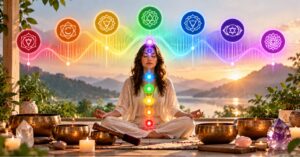
Crystal singing bowls are relatively new compared to the others on this list; however, they work from the same basic principles of vibrational medicine. Known for their crystal bowl sound healing benefits, crystal bowls are made from quartz and produce a clear, sustained note that many people describe as “cleaner” sounding and more penetrating than metal bowls. These unique sound frequencies are believed to support relaxation, emotional balance, and overall well-being.
Quartz vibrates at a consistent frequency. Our bodies are made up of a large amount of crystalline structure including our bones and even our cell membranes. Some vibrational medicine researchers believe that frequencies generated from quartz vibrating may interact with our body’s crystal structures through sympathetic resonance.
Primary uses: Chakra balancing, emotional clearing, anxiety relief, deep meditative states.
8. The Tuning Fork
Origin: Invented by British musician John Shore in 1711; therapeutic use evolved through the 19th and 20th centuries
Tuning forks actually straddle this list a little bit. They are the newest instrument on the list, but have the most immediate connection to ancient vibrational science and contemporary medicine.
They were introduced into medical practice in the 1800s as a tool for hearing exams and neurological assessments. The Weber test and Rinne test, both still administered in modern medicine, make use of tuning forks. According to this article on PMC (National Library of Medicine), tuning forks went from music to medicine and eventually found their way into sound healing practice as people began to realize that using certain frequencies applied directly to the body had applications outside of testing. Here’s how they work:
Weighted tuning forks used on the body’s bones, joints, or acupressure points allow the vibration to move through the body via tissue. This vibrational medicine stimulates the vagus nerve, encourages parasympathetic response and can help release local tension and pain.
Primary uses: Localized pain relief, nervous system regulation, acupressure point activation, chakra alignment.
9. The Shankha (Conch Shell)
Origin: Indian subcontinent and Southeast Asia, used in Vedic rituals for over 3000 years
The conch shell is not just a ceremonial object. It is an acoustic instrument with a specific acoustic profile. When blown, the shankha produces a sound that spreads omnidirectionally, filling a space with vibration in a way that few other instruments can.
In ancient Indian tradition, the shankha was blown at the beginning of ceremonies to clear the space of dissonant energy. Modern acoustic research offers a parallel explanation: the specific frequency bands produced by a conch shell correspond to ranges known to activate the parasympathetic nervous system and suppress stress responses.
Indian Ayurvedic texts describe the shankha as useful for throat and respiratory conditions, and practitioners traditionally used it in water-based treatments. A conch shell placed near the ear produces a sound that slows and deepens breathing almost reflexively. Many people have experienced this accidentally at the beach.
Primary uses: Space clearing, respiratory support, ceremonial opening, parasympathetic activation.
10. The Pythagorean Lyre
Origin: Ancient Greece, with Pythagoras integrating it into systematic healing practice around 500 BCE
Pythagoras is remembered as a mathematician, but his students knew him equally as a healer who used music as medicine. He developed a system called “musical medicine,” where specific harmonics were prescribed for specific emotional and physical conditions.
The lyre, a stringed instrument of the ancient world, was his primary tool. He taught that mathematical ratios in music, what he called “the music of the spheres,” were not merely aesthetic. They were the same ratios governing the human body. When the body fell out of harmony, music in the correct mathematical proportions could restore it.
Primary uses: Emotional regulation, sleep induction, digestive support, mental clarity, harmonic medicine.
What All Ten Instruments Have in Common
Sit with this for a moment. A Tibetan monastery in the Himalayas, an Aboriginal ceremony in Australia, a healing temple in ancient Egypt, and the court of Pythagoras in ancient Greece. These places had no contact with each other. No shared texts. No shared language.
And yet they all arrived at the same conclusion: specific sounds, applied intentionally to the human body, produce healing effects.
That convergence is not coincidence. It is an observation confirmed repeatedly across thousands of years and dozens of cultures.
The team at Five Elements (thefiveelements.in) built their entire approach on this foundation. Every program, from the Sound Healing Practitioner certification to the Nervous System Reset and Sound and Rhythm workshops, draws on both the ancient knowledge embedded in these instruments and the modern research that now explains how and why they work.
The instruments have been here all along. Science is catching up.
Frequently Asked Questions
Q1: Which ancient sound healing instrument is best for beginners?
Tibetan singing bowls are the most accessible starting point. They are easy to find, simple to use even without training, and produce measurable relaxation responses quickly. A single bowl at 432 Hz or 528 Hz is a good starting point for home practice.
Q2: Do I need to believe in sound healing for it to work on the body?
No. The physiological effects, reduced heart rate, shifts in brainwave activity, parasympathetic nervous system activation, happen regardless of belief. They are measurable through EEG and heart rate variability monitors. That said, intention and attention do appear to deepen the experience over time.
Q3: Can these ancient instruments be used alongside medical treatment?
Yes. Sound healing instruments are widely used as complementary support alongside conventional medical care, not as replacements. Many hospitals and cancer centers now offer sound therapy sessions for patients managing anxiety, pain, and sleep disruption.
Q4: Is there one instrument that works best for anxiety?
Research most consistently points to Tibetan singing bowls and gongs for anxiety reduction, based on measured changes in heart rate variability and self-reported anxiety scores. Tuning forks applied directly to the body are also strongly linked to vagus nerve stimulation, which directly lowers anxiety.
Q5: How do I know which sound healing program or instrument is right for me?
Start by noticing which sounds your body responds to most naturally. Some people feel instantly settled by low drone sounds like gongs and didgeridoos. Others respond more to the clear tones of crystal bowls or the steady hum of a tanpura. A guided session with a trained practitioner, like those offered through Five Elements, gives you direct experience of multiple instruments in one setting.