You’re holding a vibrating tuning fork pressed firmly to your body. It’s producing this perfectly clean tone pure, uncomplicated by overtones or distortion of any kind. After a moment, your body just knows. Microscopically, muscles relax. Your breath deepens without your having to think about it. You feel still in a way that isn’t just relaxation, it’s acceptance, homecoming. Sound healing with tuning forks centres around this experience, and it’s a whole lot less new-age than you might think.
Modern tuning fork therapy exists at a crossroads of physics and biology, ancient philosophy and modern research. Everything we know about tuning forks is grounded in the traditions of vibrational sound healing that predate recorded history by millennia; but what sets tuning forks apart is their razor focus. Where other instruments produce wildly complex harmonic arrays, a tuning fork vibrates at one specific frequency. It’s this precision that gives tuning forks their potency and allows us to explore their applications with such specificity.
If you’re new to tuning forks or sound healing, or even if you already practice with them regularly, this article will give you a detailed look at exactly what they are. We’ll cover the hard science, the history, the different frequencies and how they’re used, and why this simple tool can produce results that seem so much larger than itself.
The Physics of Frequency: Why Sound Can Heal
To appreciate how tuning forks can promote healing, we first need to examine what sound is. Sound is not merely something we hear – it’s physical energy. Sound created by the vibration of a tuning fork produces alternating compression and rarefaction of the surrounding medium. The medium can be air, water, or even tissue. Compression occurs when pressure waves are bouncing off of the tuning fork and into whatever matter is surrounding it, causing the matter to vibrate as well.
Human beings are made up of approximately 60-70 percent water, and water is one of the fastest conductors of sound vibration in existence. When a tuning fork’s frequency reaches tissue, fluid, and bone, it does so with great efficiency, penetrating places on the body that topical medicines, massage, or even breath work cannot reach.
Two important physical principles underlie all tuning fork therapy:
- Resonance: Every object has a natural resonant frequency, a rate at which it vibrates most efficiently. When an external frequency matching that natural frequency is applied, the object amplifies its own vibration. In the body, cells, organs, and energy centres each have characteristic frequencies.
- Entrainment: First described by Dutch physicist Christiaan Huygens in the 17th century, entrainment is the tendency of oscillating systems to synchronise with each other when one is stronger or more coherent. The brain, the heart, and the nervous system are all oscillating systems.
Types of Tuning Forks: Weighted vs. Unweighted
Not all tuning forks function the same way. The most fundamental distinction in therapeutic tuning fork work is between weighted and unweighted forks, a difference that determines both how the fork is used and what it is most effective for.
Weighted Tuning Forks
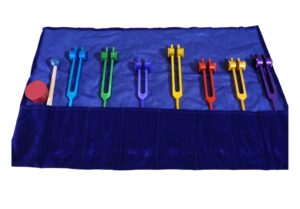
Weighted tuning forks feature small metal discs (known as bobweights) glued onto the ends of each tine. These weights reduce the rate of the vibration while increasing the amplitude of the oscillation, resulting in a stronger, longer-lasting physical vibration. Weighted tuning forks are used almost exclusively for direct contact with the body, they are placed directly on acupuncture or energy points, along the bones and joints, allowing their vibrations to transfer into the body tissue.
Sets of weighted tuning forks tuned to the frequencies associated with each of the seven main energy centres in the body are known as chakra weighted tuning forks. By striking a chakra weighted tuning fork and placing it on the body or near the corresponding energy centre, the pure tone of that frequency resonates through that centre with the intention of clearing blockages, balancing and opening the natural flow of energy through that centre. General maintenance and specific applications of each chakra are used by some practitioners.
Unweighted Tuning Forks
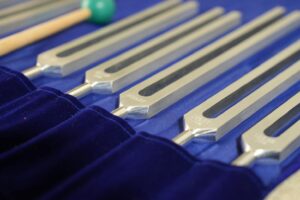
Unweighted tuning forks are just as they sound. There are no weights added to them. They vibrate at a quicker rate, hold their tone longer and the vibrations create a cleaner sound that projects out into the environment rather than transferring through touch. For this reason unweighted forks are used mainly on the energy field surrounding the body or biofield/aura vs the physical tissues themselves.
Chakra unweighted tuning forks are tuned to the same frequency sets as the weighted forks. The difference is that they work on auditory and biofield levels rather than vibrational transfer through physical matter. The unweighted forks are moved around the body in sweeping motions or circles and the sound waves they project affect the electromagnetic field as well as the subtle energy layers of the human field. Many people find that chakra unweighted tuning forks are extremely useful for emotional clearing, energetic clearing for protection, and trauma that is stored in the field.
Common Tuning Fork Frequencies and Their Applications
Different frequencies are used for different purposes in sound healing practice. Here are some of the most commonly used tuning fork frequencies and what they are known to address:
- 128 Hz — One of the most foundational frequencies in tuning fork therapy. Applied directly to bones and joints, it stimulates nitric oxide release, reduces inflammation, and promotes cellular repair. Widely used for musculoskeletal pain and nervous system regulation.
- 256 Hz (C) and 384 Hz (G) — The fundamental musical interval of a perfect fifth. When struck together and moved around the body, these two frequencies create a rapidly oscillating wave between them that is profoundly calming to the nervous system.
- 432 Hz — Sometimes called “the natural tuning,” 432 Hz is associated with a warm, grounding quality. Proponents suggest it resonates more harmonically with natural systems and biological processes than the standard 440 Hz concert pitch.
- 528 Hz — Known in some traditions as the “Love Frequency” or “Miracle Tone,” 528 Hz is associated with DNA repair and cellular regeneration in some independent research, and is widely used in vibrational sound healing for emotional healing and heart-centred work.
- Solfeggio Frequencies (396, 417, 528, 639, 741, 852 Hz) — A series of ancient tones historically embedded in Gregorian chant. Each frequency is associated with a specific domain of healing: releasing fear, facilitating change, healing relationships, awakening intuition, and returning to spiritual order.
- Planetary Frequencies — Based on the work of Swiss mathematician Hans Cousto, who calculated the vibrational frequencies of planetary orbits and transposed them into audible ranges. Each planet corresponds to specific physiological and psychological domains.
What Happens During a Tuning Fork Session?
One common method to experience tuning fork therapy starts with you lying fully clothed on a treatment table in a softly lit room. Most practitioners will start a session by asking questions and/or feeling into where you are in your body, emotions, and energy at that moment either verbally, by scanning your biofield with their hands, or lightly using a grounding fork.
During the tuning fork session, your practitioner will strike the forks onto either a hockey puck- style activator or their palm (never on stone counters or anything else that feels hard which will disrupt the calibration of the forks) and then hold them on points on your body or move them around your energy field. Sessions can range anywhere from 45 minutes to an hour and fifteen minutes. Many describe tuning fork sessions as intensely meditative where most people enter theta brainwaves states and release spontaneously from their bodies in the form of yawns, sighs, body movement. Some people even report experiencing a quality of stillness that they have not known otherwise.
Integration time is highly encouraged after your session. Lie down, drink plenty of water, turn off your electronics, and relax. Some benefits can take 24-48 hours to resonate through the body. Sleep, clear emotions, and feeling lighter are commonly experienced days after a session.
Conditions and Situations Tuning Fork Therapy May Support
Tuning fork therapy is used across a broad spectrum of situations, from acute physical complaints to chronic patterns of imbalance, emotional work, and spiritual development. Practitioners and clients report meaningful support in the following areas:
- Chronic pain, particularly in joints, the spine, and areas of persistent muscular tension
- Anxiety, nervous system dysregulation, and the physical symptoms of chronic stress (tight chest, shallow breathing, insomnia)
- Emotional processing — grief, anger, fear, and unresolved trauma held in the body
- Energetic imbalances associated with specific chakras — low energy, creative blocks, difficulty with communication, relationship challenges
- Post-surgical or post-illness recovery, where accelerating cellular repair and reducing inflammation is desirable
- Mental clarity, focus, and cognitive performance — particularly when neural coherence has been disrupted by stress or overwork
- Spiritual deepening — supporting meditation practice, expanding states of awareness, and facilitating experiences of inner stillness
- General preventive maintenance — regular sessions as energetic hygiene, similar to how one might use yoga, acupuncture, or massage as a regular wellness practice
Learning Tuning Fork Therapy: Where Expert Guidance Matters
Working with tuning forks is simple enough that eager students can start playing with it themselves after a short while, and profound enough that learning from someone who already knows how it works can make all the difference between an enjoyable experience and one that is unsafe or ineffective. There’s an energetic skill in knowing what frequency to use, where on the body to place it, how strongly to apply pressure, how long to vibrate the fork, and in what order to address different tones.
If you’re looking for a more formal introduction to the world of vibrational sound healing (and tuning fork work as part of an integrated system), Five Elements has developed courses that combine time-honoured healing wisdom with contemporary therapeutic insight. I like how thoroughly Five Elements immerses students in the world of sound healing: they go beyond how to use sound tools as a healer and teach you about the energetic intelligence required for good sound healing practice.
Curious about sound healing? Considering it as a career path? Starting with practice sessions and sound healing workshops that emphasise mastery rather than how quickly you can learn ensures you have a truly solid base to build from (something self-learning often struggles to achieve).
Can You Practice Tuning Fork Therapy at Home?
Of course, within reason. Practicing on yourself with tuning forks is a wonderful extension of clinical practice for continued nervous system regulation, energy building, and assisting with emotional well-being. A pair of forks tuned to a fifth (example: 256Hz and 384Hz) can easily be learned with minimal guidance and allow for daily stress management.
When using tuning forks for the chakra system, whether that be chakra unweighted tuning forks for use on the energy body or chakra weighted tuning forks for use on the physical body — it’s best to have some guidance. Understanding which fork to use on which centre, how to identify which centres to target, and in what order for how long can turn somatic pleasure into an intentional healing practice.
The forks themselves are important as well. Medical grade tuning forks are engineered to very tight tolerances and will hold their tuning longer. Consumer grade forks that are not manufactured to any specification can slowly fall out of tune, negating your purpose. Purchase from a trusted vendor if you plan on using them seriously.
Closing Reflections
Sound healing courses with tuning forks are not woo-woo. It’s an exact, effective healing practice rooted in science, physiology, and thousands of years of tradition. We’re learning more about how it works every day from the scientific community, the effects are repeatable and widely experienced, and it can be used for just about anything from basic relaxation to high-end spirituality.
But what sets tuning fork therapy apart from many practices in the wellness world today is that it doesn’t just relax you and trigger a placebo effect (though it does both of those things alongside REAL therapeutic benefits). It provides you with a specific frequency containing a known healing mechanism, for a specific purpose, that your body responds to in a measurable way. That’s powerful for practitioners and clients alike. We know what we’re doing, and we know that it works. As research into vibrational sound healing grows, that level of certainty can be rare.
If you haven’t experienced a professional tuning fork session yet, treat this as your invitation. Your body has been craving these frequencies, it just knows what to do when they show up.
Frequently Asked Questions
Q1. What is the difference between chakra weighted tuning forks and chakra unweighted tuning forks?
Chakra weighted tuning forks are designed for direct physical contact with the body. Their added metal weights produce a stronger physical vibration that transmits through tissue, muscle, and bone, making them particularly effective for releasing physical tension and addressing structural imbalances associated with specific energy centres. Chakra unweighted tuning forks, without the added weights, produce a sustained auditory tone used in the biofield, the electromagnetic energy field surrounding the body.
Q2. Is sound healing with tuning forks safe for everyone?
Tuning fork therapy is generally considered extremely safe and non-invasive, with no known side effects when applied competently. However, there are specific contraindications to be aware of. Direct application of weighted forks is not recommended over fractures, acute injuries, areas of active inflammation, or implanted metal devices such as pacemakers or certain orthopaedic implants. Pregnant women should avoid direct application to the abdominal area, particularly in the first trimester.
Q3. How many tuning fork sessions are typically needed to experience significant results?
This depends significantly on what is being addressed and the individual’s starting point. Many people report noticeable shifts in relaxation, sleep quality, and emotional ease after a single session. For deeper work, addressing chronic pain patterns, longstanding emotional blockages, or significant energetic imbalances, practitioners generally recommend an initial series of three to six sessions to allow cumulative effects to develop.
Q4. How do tuning forks relate to broader vibrational sound healing practices?
Tuning forks are one instrument within the broader category of vibrational sound healing, which encompasses singing bowls, gongs, drums, voice, and other sound-producing tools. What distinguishes tuning forks within this field is their frequency precision, each fork produces a single, defined, calibrated frequency rather than a complex harmonic spectrum.
Q5. What should I look for when choosing a sound healing course that covers tuning fork therapy?
Look for courses that cover both the theoretical foundations, physics of sound, anatomy of the chakra system, energetic anatomy and provide significant hands-on practice time. The best sound healing courses offer direct experience both giving and receiving treatment, supervised practice with feedback, and instruction in assessment skills so you can identify what a client or yourself needs rather than applying a fixed protocol. A good course will also address ethics, contraindications, and scope of practice clearly.